
In the bustling world of technology startups, where urban centers and corporate attire dominate, Sridhar Vembu stands out as a beacon of unconventional success. Residing in a quaint village in Tamil Nadu, donning a traditional lungi, and commuting on a bicycle, Vembu has orchestrated the rise of Zoho Corporation into one of India’s most profitable startups. With a net profit surpassing ₹2,800 crore in the fiscal year 2023 (m.economictimes.com), Zoho’s journey under Vembu’s leadership offers invaluable insights into sustainable and self-reliant business growth.
Humble Beginnings and Academic Pursuits
Born in 1968 in a modest village in Thanjavur district, Tamil Nadu, Vembu’s early life was rooted in simplicity. His father served as a stenographer in the High Court, and the family prioritized education despite limited means. Demonstrating exceptional academic prowess, Vembu secured the 27th rank in the Joint Entrance Examination (JEE), leading him to pursue electrical engineering at the Indian Institute of Technology (IIT) Madras. His quest for deeper knowledge propelled him to Princeton University, where he earned his Ph.D. in Electrical Engineering (en.wikipedia.org).
The Genesis of Zoho Corporation
In 1996, driven by a vision to generate employment in India and elevate the nation’s technological stature, Vembu, along with his brothers, founded AdventNet in Chennai. Initially focused on hardware manufacturing, the company faced financial constraints, prompting a strategic pivot to software development—a domain requiring less capital yet offering vast potential. Operating from a modest setup with two computers, the team embarked on creating software solutions tailored for smaller businesses, distinguishing themselves in a market saturated with high-cost offerings from established giants (startuptalky.com).
Zoho’s Financial Growth Over the Years
To understand Zoho’s financial success, the following table highlights the company’s revenue and net profit growth in recent years:
| Fiscal Year | Revenue (₹ Crore) | Net Profit (₹ Crore) |
|---|---|---|
| 2020 | 5,230 | 1,917 |
| 2021 | 6,710 | 2,240 |
| 2022 | 7,500 | 2,500 |
| 2023 | 8,703 | 2,836 |
Revenue and Profit Growth Chart
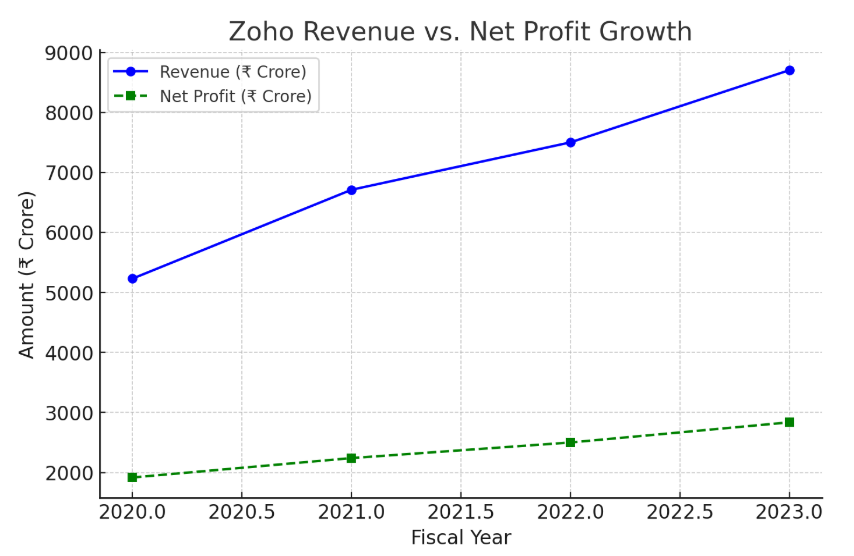
Key Financial Trends:
- Consistent Revenue Growth: Zoho’s revenue has grown steadily, reflecting its strong market presence and expanding customer base.
- Sustained Profitability: Unlike many startups that focus on valuation, Zoho has maintained high profitability.
- Debt-Free Growth: The company has achieved this growth without external funding, making it one of the rare self-reliant unicorns.
A Distinctive Business Philosophy
Zoho’s ascent is deeply rooted in Vembu’s commitment to self-sufficiency and sustainable growth. Eschewing external investments and debt, the company has expanded organically, reinvesting profits to fuel innovation and development. This approach has preserved the company’s autonomy, allowing for long-term strategic planning without external pressures.
Commitment to Rural Development and Talent Cultivation
Vembu’s dedication to societal impact is evident in his efforts to decentralize operations and foster rural development. Relocating to Mathalamparai village in Tamil Nadu, he has been instrumental in transforming rural landscapes into tech hubs. Initiatives like Zoho Schools of Learning offer vocational education to rural youth, equipping them with industry-relevant skills and providing employment opportunities within the company.
Employee Growth at Zoho
The table below demonstrates Zoho’s increasing workforce:
| Year | Number of Employees |
| 2018 | 5,000 |
| 2020 | 7,500 |
| 2022 | 10,000 |
| 2023 | 12,000 |
Employee Growth Chart
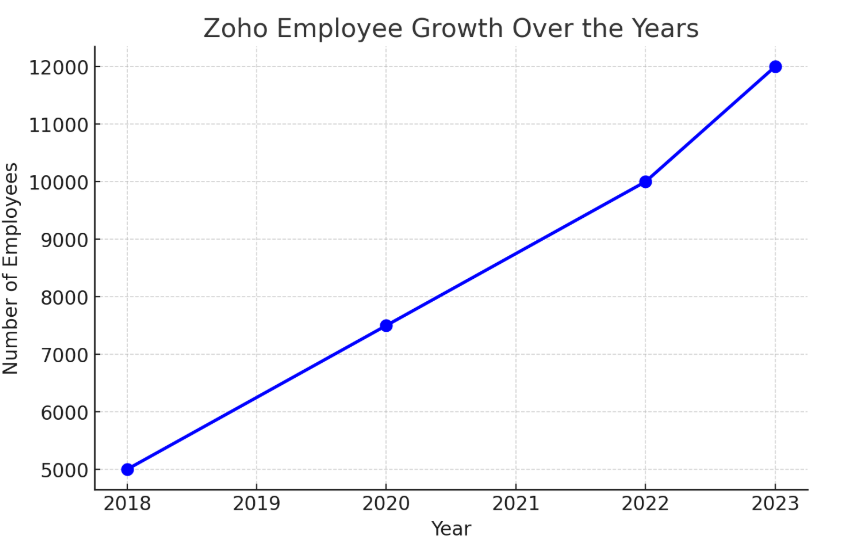
Workforce Expansion Insights:
- Rapid Hiring: Zoho’s workforce has more than doubled in five years, highlighting its expansion.
- Focus on Skill Development: The company invests in upskilling employees rather than relying solely on external hiring.
- Rural Employment Opportunities: Many of these hires come from non-urban backgrounds, supporting Vembu’s rural development mission.
Lessons from Sridhar Vembu’s Entrepreneurial Journey
Sridhar Vembu’s trajectory offers several key takeaways for aspiring entrepreneurs:
- Embrace Resilience: Challenges are integral to the entrepreneurial journey. Viewing obstacles as opportunities for innovation can lead to transformative solutions.
- Prioritize Self-Reliance: Building a business organically fosters autonomy and long-term stability, reducing dependency on external capital.
- Invest in Talent Development: Empowering local communities through education and employment not only drives business success but also contributes to societal progress.
- Focus on Product Excellence: A superior product naturally attracts and retains customers, minimizing the need for aggressive marketing.
Final Thoughts
In an era where startups often chase rapid growth through external funding, Sridhar Vembu’s approach with Zoho exemplifies the power of sustainable practices, community engagement, and unwavering commitment to quality. His journey from a village in Tamil Nadu to the helm of a global software powerhouse serves as an inspiring blueprint for entrepreneurs worldwide.
With Zoho continuing its upward trajectory, its unique model of profitability, self-sufficiency, and rural empowerment is a testament to the possibilities of sustainable entrepreneurship in the modern digital economy.