
Indian Railways isn’t just a transport network; it’s the nation’s lifeline. Carrying over 23 million passengers daily and hauling millions of tonnes of freight, it’s a colossal entity. But decades of underinvestment, operational inefficiencies, safety concerns, and financial strain have sparked a heated debate: Should Indian Railways be privatized?
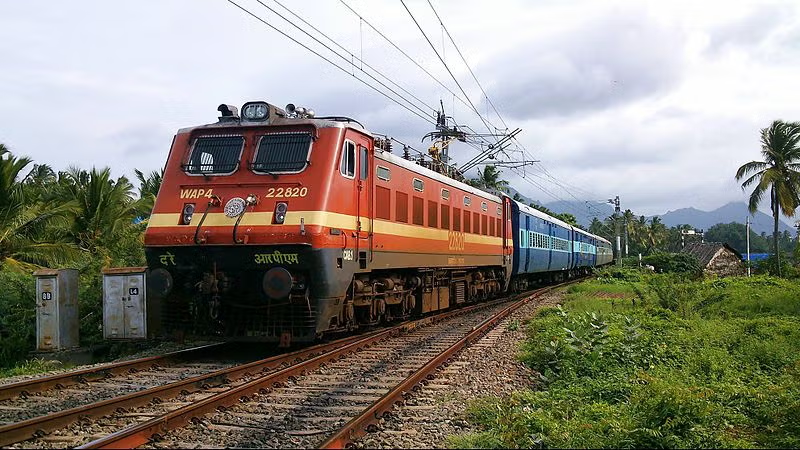
It’s a complex question with passionate arguments on both sides. Let’s navigate the tracks of this debate, examining the potential benefits, risks, challenges, and what the future might hold, drawing lessons from global examples.
The Case FOR Privatization: Chugging Towards Efficiency?
Proponents argue privatization could be the much-needed engine upgrade:
- Enhanced Efficiency & Punctuality: Private operators, driven by profit and competition, are expected to streamline operations, reduce delays, and improve on-time performance significantly. (Think Japan’s famously punctual privatized railways).
- Improved Passenger Experience: Expect modern, cleaner trains, better onboard amenities (catering, Wi-Fi, entertainment), upgraded stations, and potentially more user-friendly booking systems. Customer service should become a priority.
- Infrastructure Boost & Modernization: Private investment can inject massive capital for track upgrades, new rolling stock (trains), signaling systems (like Kavach), and station redevelopment, reducing the government’s fiscal burden.
- Innovation & Technology Adoption: Private players are often quicker to adopt cutting-edge tech (AI for maintenance, predictive analytics, seamless ticketing apps) and introduce new service models.
- Financial Sustainability: Reducing the massive operational losses and subsidies currently borne by the government. Private operators bear the risk and aim for profitability.
- Focus on Core Functions: Allows Indian Railways to focus on its core social obligations (like running loss-making but essential rural routes) and strategic network management.
The Risks & Disadvantages: Potential Derailments
Critics warn of significant downsides:
- Soaring Fares: The biggest fear. Private operators prioritize profit, potentially making train travel unaffordable for the masses, especially on popular routes. (A lesson learned from the UK’s experience post-privatization).
- Neglect of Social Obligations: Unprofitable rural and remote routes could be abandoned or see drastically reduced services, isolating communities. Who will serve these areas?
- Job Losses & Labor Concerns: Privatization often leads to workforce restructuring. Job security for lakhs of railway employees is a major worry, alongside potential erosion of hard-won labor rights.
- Safety Compromises? Could the relentless pursuit of profit lead to corners being cut on safety maintenance and training? Robust, independent regulation is absolutely critical.
- Fragmentation & Coordination Issues: Multiple operators could lead to complex ticketing, lack of seamless transfers, and coordination nightmares during disruptions. (Another challenge seen in the UK).
- Monopolies on Profitable Routes: Instead of competition, private players might dominate specific high-demand corridors, leading to monopolistic pricing and service issues.
Navigating the Challenges: The Steep Gradient Ahead
Making any privatization model work requires overcoming huge hurdles:
- Regulatory Framework: Establishing a powerful, independent regulator is non-negotiable. This body must ensure fair competition, prevent monopolies, enforce safety standards, protect passenger rights, and mandate service on unprofitable routes.
- Labor Transition: A humane and strategic plan for the existing workforce is essential – retraining, redeployment, or fair severance. Strikes and unrest can derail the entire process.
- Fair Competition & Bidding: Transparent processes to award routes/franchises, preventing cronyism and ensuring genuine competition.
- Balancing Profit & Public Service: Designing contracts (like Public-Private Partnerships – PPPs) that incentivize private investment while safeguarding public interest and accessibility.
- Political Will & Public Acceptance: Overcoming ideological resistance and managing public perception, especially regarding fare hikes.
Global Lessons: What Can India Learn?
- Japan (Success Story): Japan National Railways (JNR) was privatized into regional JR companies in 1987. Results? Dramatically improved efficiency, profitability, safety, and service quality. Why it worked: Strong initial restructuring, clear separation of track & operations (in some regions), and a culture prioritizing punctuality and service. Lesson: Comprehensive restructuring and cultural alignment are key.
- United Kingdom (Cautionary Tale): Privatized in the 1990s, splitting track (Railtrack, later Network Rail) from train operators. Results? Mixed. While some services improved, it led to complex coordination, high fares, periodic chaos after infrastructure failures, and public dissatisfaction. Lesson: Fragmentation without robust coordination and regulation is risky. Overly complex structures can backfire.
- Germany & France (Hybrid Models): Maintain state-owned infrastructure companies (DB Netz, SNCF Réseau) while allowing private operators (both freight and some passenger) to run trains on the tracks for a fee. Lesson: Separating infrastructure ownership from train operation can foster competition while retaining state control over the core network.
India’s Path Forward: Hybrid Models & Cautious Experimentation
A full-scale, overnight privatization of the entire Indian Railways is highly unlikely and probably undesirable. India seems to be exploring a hybrid approach:
- PPP Models: Private investment in specific areas – station redevelopment (e.g., Habibganj, Gandhinagar), running private trains on IR tracks (like the initial Tejas Express model), dedicated freight corridors (DFCCIL already uses PPP elements).
- Corporatization: Converting specific services or units (like IRCTC, IRFC, CONCOR) into more autonomous, profit-driven entities under the Railways umbrella.
- Route Franchising: Allowing private operators to bid for operating clusters of trains on specific high-demand routes (Mumbai-Ahmedabad, Delhi-Kolkata etc.), while IR retains infrastructure ownership and regulates fares/safety.
The Destination?
Privatization of Indian Railways isn’t a binary “yes or no.” It’s about finding the right balance. Strategic private participation, focused on specific areas like modern trains, station upgrades, and freight logistics, coupled with a powerful regulator and safeguards for social obligations, holds promise.
The goal shouldn’t be just profit, but a better railway for all Indians: efficient, safe, modern, and accessible. It’s a long, complex journey requiring careful planning, strong governance, and constant course correction. The ride has begun – whether it’s smart or risky depends entirely on how the tracks are laid.
Key Takeaways:
- Potential Upsides: Efficiency, Better Service, Investment, Innovation.
- Major Downsides: Higher Fares, Neglected Routes, Job Fears, Safety Risks.
- Critical Success Factors: Strong Regulation, Fair Labor Plan, Balanced Contracts.
- India’s Likely Path: Hybrid Model (PPPs, Corporatization, Route Franchising).
- Global Wisdom: Learn from Japan (restructure well), UK (avoid fragmentation pitfalls), EU (infrastructure separation).