
“Products are made in the factory, but brands are created in the mind.” – Walter Landor
Darshan Patel, the visionary behind iconic brands like Moov, Krack, Itch Guard, Set Wet, Dermi Cool, D’Cold, and Fogg, revolutionized the Indian consumer market without a formal education. His most celebrated creation, Fogg by Vini Cosmetics, is a testament to his entrepreneurial acumen and deep understanding of consumer behavior.
In this blog, we’ll explore how Fogg dethroned established players like Axe to become the market leader in India’s deodorant industry. We’ll also break down the strategies that made Fogg a household name, with insights that can be applied to any business or research article.

The Indian Deodorant Market: A Snapshot
The Indian perfumes and deodorants market was valued at $1.35 billion in 2023. Fogg has consistently held a 20% market share, making it the undisputed leader. Within just one year of its launch, Fogg overtook Axe, and within five years, it contributed to 90% of Vini Cosmetics’ revenue.
| Metric | Value |
|---|---|
| Market Size (2023) | $1.35 billion |
| Fogg’s Market Share | 20% |
| Monthly Sales (2023) | 60 million cans |
| Revenue Contribution | 90% of Vini Cosmetics’ income |
The Origin of Fogg: A Lesson in Consumer Insight
In 2011, Vini Cosmetics launched a deodorant called 18+, which failed to make an impact. Darshan Patel realized he had overlooked a critical consumer insight. He went back to the drawing board, conducting extensive research across eight major Indian cities.
The key finding? Consumers were frustrated that their deodorant cans ran out too quickly. This led to the birth of Fogg, with its iconic tagline: “Bina gas wala spray” (a deodorant without gases). Fogg promised 800 sprays per can, addressing the longevity issue head-on.
The Rise of Fogg: A Second Inning for Darshan Patel
After exiting Paras Pharmaceuticals due to family differences, Patel initially focused on his 300-acre fruit orchard farm. However, a friend’s suggestion reignited his entrepreneurial spirit. He invested ₹60 crore to establish Vini Cosmetics in 2010, and Fogg was launched in 2011.
Fogg’s success was built on two pillars:
- Affordability: Competitive pricing for a cost-conscious Indian market.
- Longevity: A promise of 800 sprays per can, ensuring value for money.
Fogg’s Marketing Strategy: Breaking the Mold
Fogg didn’t follow the traditional playbook of deodorant advertising, which often relied on masculine imagery and the “attract women” narrative. Instead, Fogg’s campaigns were fresh, humorous, and relatable.
Key Campaigns
- No Gas Perfume: Highlighted the unique liquid formulation.
- Kya Chal Raha Hai? – Fogg Chal Raha Hai: A catchy, conversational tagline that became part of everyday language.
- Aur Kya Chahiye?: Emphasized that Fogg offered everything a consumer needed.
These campaigns resonated deeply with Indian audiences, making Fogg a cultural phenomenon.
The 4 Ps of Fogg’s Marketing Strategy
| P | Strategy |
|---|---|
| Product | – No-gas, liquid deodorant formulation. – Guaranteed 800 sprays. – Separate variants for men and women. |
| Price | – Competitive pricing. – Psychological pricing (e.g., ₹199 instead of ₹200). |
| Promotion | – Humorous and relatable ad campaigns. – Viral marketing strategies. |
| Place | – Wide availability across retail stores and supermarkets. – Appeals to all socio-economic classes. |
Understanding Consumer Needs: The Secret Sauce
Fogg’s success lies in its ability to address consumer pain points:
- Longevity: Consumers wanted a deodorant that lasted longer.
- Affordability: Fogg offered premium quality at competitive prices.
- Branding: Names like “Napoleon,” “Royal,” and “Majestic” created a premium perception.
Key Takeaways
- Fogg disrupted the market by focusing on product differentiation rather than aggressive advertising.
- It leveraged the value-for-money positioning to attract price-sensitive consumers.
- Smart word-of-mouth marketing and point-of-sale promotions played a pivotal role in its growth.
- The brand achieved ₹1000+ crore in annual sales, outpacing major competitors.
Identifying a Market Gap
Before Fogg’s entry, the Indian deodorant market was dominated by gas-based sprays, with brands focusing heavily on celebrity endorsements and flashy advertisements. Vini Cosmetics, led by Darshan Patel, identified a crucial pain point: most deodorants contained gas, leading to fewer usable sprays per can.
Fogg’s Unique Selling Proposition (USP):
- No Gas, Only Liquid: Instead of gas-based deodorants, Fogg introduced a liquid-based formula, ensuring a longer-lasting product.
- More Sprays per Bottle: A single can of Fogg provided 800+ sprays, compared to competitors offering only 200-300 sprays.
- Clear Consumer Message: The tagline “No Gas, Only Perfume” made its value proposition instantly clear to consumers.
Market Strategy: How Fogg Succeeded Without Ads
Unlike its competitors, Fogg did not rely on celebrity endorsements or expensive TV campaigns. Instead, it focused on smart marketing tactics that ensured massive brand penetration.
1. Word-of-Mouth Marketing
- Fogg relied on customer recommendations and in-store promotions to spread awareness.
- Positive reviews and social media buzz amplified its credibility.
- Instead of spending on TV ads, it invested in better distribution and retail visibility.
2. Data-Driven Pricing Strategy
| Brand | Price (₹) | Sprays per Can | Gas-Based? |
|---|---|---|---|
| Fogg | 199 | 800+ | ❌ No |
| Axe | 220 | 250-300 | ✅ Yes |
| Nivea | 225 | 250-300 | ✅ Yes |
| Park Avenue | 250 | 300-350 | ✅ Yes |
- Fogg positioned itself as a cost-effective alternative, delivering 3x more sprays per rupee.
- It won the trust of value-conscious Indian consumers who preferred long-lasting products.
3. Retail & Point-of-Sale (POS) Dominance
- Fogg focused on large-scale retail partnerships to ensure visibility at major supermarkets and local stores.
- Eye-catching packaging and point-of-sale displays helped attract walk-in customers.
- Instead of mass media, Fogg ran in-store promotions with discounts and combo offers.
How Fogg Outperformed Competitors
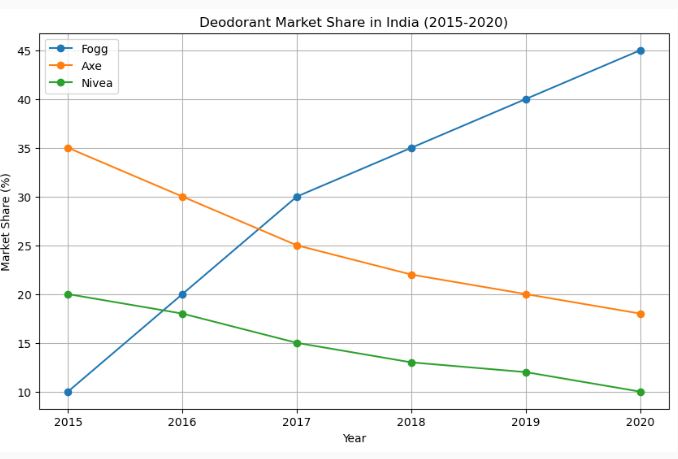
Deodorant Market Share in India (2015-2020)
| Year | Fogg Market Share (%) | Axe Market Share (%) | Nivea Market Share (%) |
|---|---|---|---|
| 2015 | 10% | 35% | 20% |
| 2016 | 20% | 30% | 18% |
| 2017 | 30% | 25% | 15% |
| 2018 | 35% | 22% | 13% |
| 2019 | 40% | 20% | 12% |
| 2020 | 45% | 18% | 10% |
Graph: Growth of Fogg vs. Competitors
Lessons from Fogg’s Success
Fogg’s journey offers valuable business insights:
- Product Innovation Wins: Identifying a consumer pain point (gas-based sprays) helped Fogg create a niche.
- Advertising is Not Always Necessary: If the product is unique and valuable, word-of-mouth and strategic positioning can drive success.
- Value-Based Pricing Works: Consumers prefer products that offer tangible benefits, even at a similar or slightly higher price.
- Retail Visibility is Key: Rather than focusing on digital or TV ads, Fogg ensured strong in-store visibility.
Conclusion
Fogg’s rise without traditional advertising is a testament to the power of product differentiation, smart retail strategy, and word-of-mouth marketing. By prioritizing consumer needs over marketing glitz, Fogg transformed from an underdog to the No.1 deodorant brand in India.
For businesses, this case study highlights that a well-positioned product with clear benefits can outperform even the biggest ad-heavy competitors.
For more articles, visit Finshots Daily.